

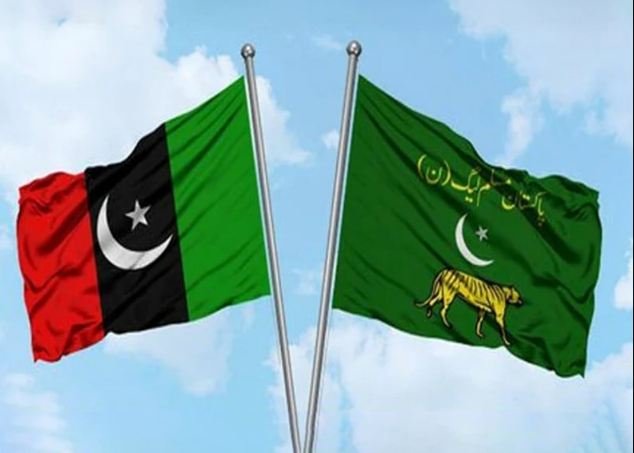
PML-N & PPP Half-Term Deal: What’s True?
Senate Chairman Yousaf Raza Gillani has stated that during the formation of the current government, Pakistan Muslim League-Nawaz (PML-N) and Pakistan Peoples Party (PPP) had agreed on a half-term power-sharing arrangement. According to him, he was not directly part of the negotiations but was informed that both parties had settled on sharing the terms of the Prime Minister, Speaker, and Chairman Senate—each for half of the government’s tenure. Gillani added that these understandings still exist at the leadership level and remain an internal matter between the top decision-makers of both parties.
To verify the claim, leaders from both PML-N and PPP as well as political analysts, were consulted.
Senior PPP leader Qamar Zaman Kaira said that before the formation of the coalition government following the general elections, a written agreement between PML-N and PPP did exist and was made available to the media. However, the written document did not include any clause about changing the Prime Minister midway or dividing the five-year term into 2.5 years each. He clarified that such a suggestion was indeed discussed informally—that Shehbaz Sharif would serve for the first half and Bilawal Bhutto-Zardari for the second—but it was never put into writing and is not currently under serious consideration.
Senior analyst Ansar Abbasi told the media he was unaware of any such power-sharing formula at the time of government formation. He questioned that if the agreement existed, would Bilawal become Prime Minister while Asif Ali Zardari remained President, the Balochistan Chief Minister remained from PPP, and Gillani stayed Chairman Senate? Abbasi expressed doubt that such a major agreement could have remained secret for nearly a year without any discussion in the media.
Analyst Ahmed Waleed also questioned the claim, saying that if a half-term power-sharing deal truly existed, preparations for the transition would have become visible by now. He noted that the PML-N currently enjoys a simple majority in the National Assembly even without the PPP, making it difficult for the PPP to enforce such an arrangement at this stage.
According to Waleed, both major parties acknowledge that Pakistan is operating under a “hybrid system,” and any power-sharing formula would also require approval from the forces behind that system—something not evident at present. He argued that the economy has only recently stabilized and foreign investments have begun to arrive. A change in government at this stage would undermine investor confidence, making such a transition highly unlikely.

Comments are closed, but trackbacks and pingbacks are open.